
Contractor, supplier, and visitor management and control software

Do you know who’s cleared to operate in and enter your company?

NAVA turns your company’s rules into operational control: you define what each person, vehicle, or piece of machinery that interacts with your operation must meet, the third party uploads the information, your team (or NAVA) validates it, and the system determines, in real time, who’s cleared to enter and operate.

ARLMedical examSOATInsurance policyOHS induction
0

types of elements under control

People, vehicles, and machinery

0

ways to process an entry at the gatehouse

ID number, license plate, serial number, or QR code

0

maximum turnaround for document validation

With the NAVA back office

0

days of free trial

On NAVA 360

  • Colombian software
  • In-house back office
  • AWS infrastructure
  • Human technical support

The ecosystem

A qualification and operational control ecosystem for third parties, access, and training

NAVA connects the entire qualification cycle for the people who interact with your operation: it identifies, defines requirements, verifies, trains, authorizes, and monitors.

  1. 01

    Who are they, and what do they need to meet?

    Register each third party and link them to their company, role, activity, vehicle, or equipment. NAVA uses this information to determine which requirements apply based on the rules the organization defines.

    NAVA 360
  2. 02

    What requirements do they need to meet?

    The company configures its requirements by type of person, activity, contractor, or risk: documents, validity periods, training, and any other conditions needed for their qualification.

    NAVA 360
  3. 03

    Do they really comply?

    Documents are uploaded and processed by NAVA. Technology and AI help extract and verify information and spot dates, inconsistencies, and conditions that need attention. The team in charge keeps control over the required approvals.

    NAVA 360
  4. 04

    Are they ready to operate?

    The third party receives the training or inductions that apply to their activity. NAVA manages assignments, content, assessments, attendance, and certifications, generating the evidence needed for their qualification.

    NAVA 360 · NAVA Skills
  5. 05

    Can they enter or operate?

    When the defined conditions are met, the person can be authorized to interact with the operation. NAVA connects compliance information with access control, so you can validate who’s authorized at the point of entry.

    NAVA 360 · NAVA ID
  6. 06

    Are they still compliant?

    Qualification isn’t permanent. NAVA keeps track of expirations, training, requirements, and access conditions, generating alerts and traceability so the organization can act before a compliance gap appears.

    NAVA

One data point at the end of the cycle

At the end of the cycle, there’s only one data point your operation needs: cleared for entry, yes or no. NAVA calculates it automatically from the status of each restrictive document.

ARL — Jhon Ospina Entry-restrictive · 30-day validity period
Uploaded
In review
Approved
Cleared for entry

The NAVA qualification cycle

From requirement to control: NAVA connects the entire qualification cycle

Your company defines the conditions. NAVA turns them into a digital process that identifies, verifies, trains, qualifies, and controls the outside people who interact with your operation.

From the third party’s registration to their entry and ongoing presence, the information stays connected, traceable, and up to date.

  1. Identify

    The third party registers and links its people, vehicles, and equipment to the organization. NAVA uses this information to determine which requirements apply based on their activity, profile, and operating conditions.

    • Third-party self-service
    • People, vehicles, and machinery
    • Supplier registration
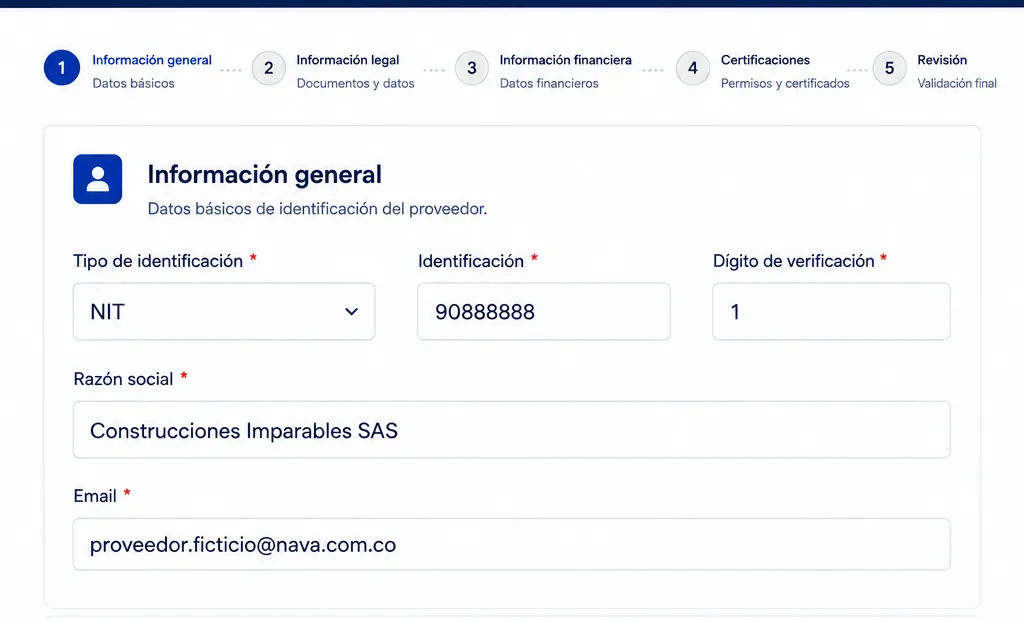
    Supplier registration form in NAVA, with the five-step wizard and the general information section filled in
    The third party manages its own information, and the company gains visibility from the start.
  2. Define — The company sets the requirements

    Every organization has different needs. NAVA lets you configure which requirements each company, person, vehicle, or piece of equipment must meet based on their activity, validity period, approval criteria, and restriction conditions.

    The company defines the requirements once, and NAVA applies them throughout the process.

    • Requirements matrix
    • Validity periods and alerts
    • Approval criteria
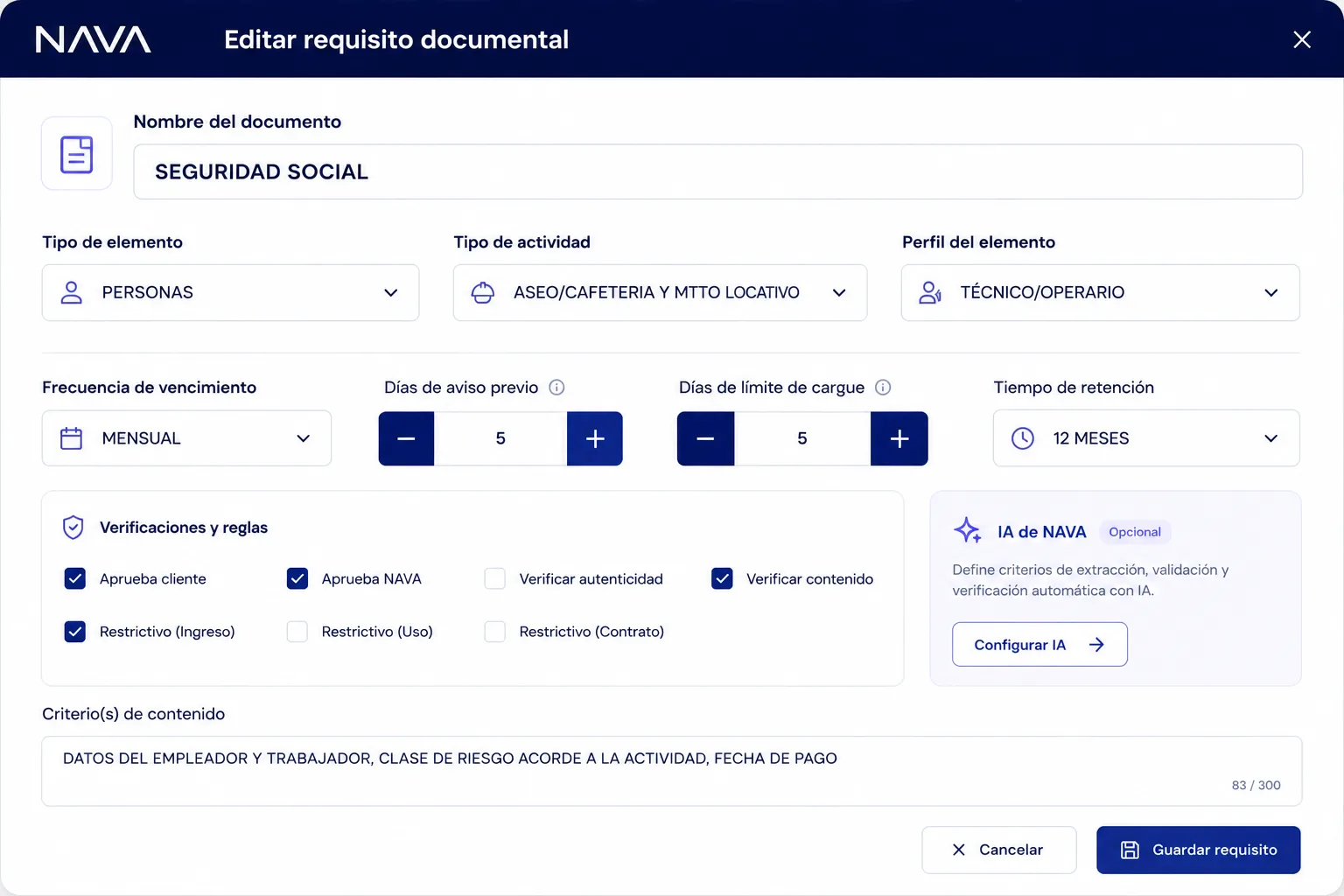
    Editing a document requirement in NAVA: element type, activity type, profile, expiration frequency, advance-notice days, verifications, and content criteria
    The organization’s requirements become controls inside NAVA.
  3. Verify — Technology and AI for smarter validation

    The third party uploads its documents, and NAVA organizes the information needed for review.

    The platform can use automation and artificial intelligence to extract and analyze document information and identify relevant data, dates, and inconsistencies, or your company’s team can do it.

    The person in charge of the process keeps the judgment and control over the final approval decision.

    • Document validation
    • Automation
    • Artificial intelligence
    Document review in NAVA: the file on the left, and the approved status, the element’s data, and the verified criteria on the right
    Technology cuts repetitive work so the team can focus on the decisions that require judgment.
  4. Train — Training reaches workers and third parties

    Qualification doesn’t depend on documents alone.

    NAVA lets you manage third-party training based on their needs, activity, or risk.

    With NAVA Skills, the organization assigns training, and the worker can receive the content, interact, take assessments, and get certified through WhatsApp, while the company keeps the tracking and the evidence.

    • Third-party training
    • WhatsApp
    • Certifications
  5. Qualify — A person meets the conditions. NAVA turns that compliance into qualification

    NAVA consolidates the information on requirements, documents, training, and any other conditions the company defines to determine the status of each person or element.

    That way, the organization can know:

    • Are they cleared?
    • What are they missing?
    • Why aren’t they cleared?

    Information stops being scattered and becomes an operational decision.

    • Compliance status
    • Traceability
    • Qualification
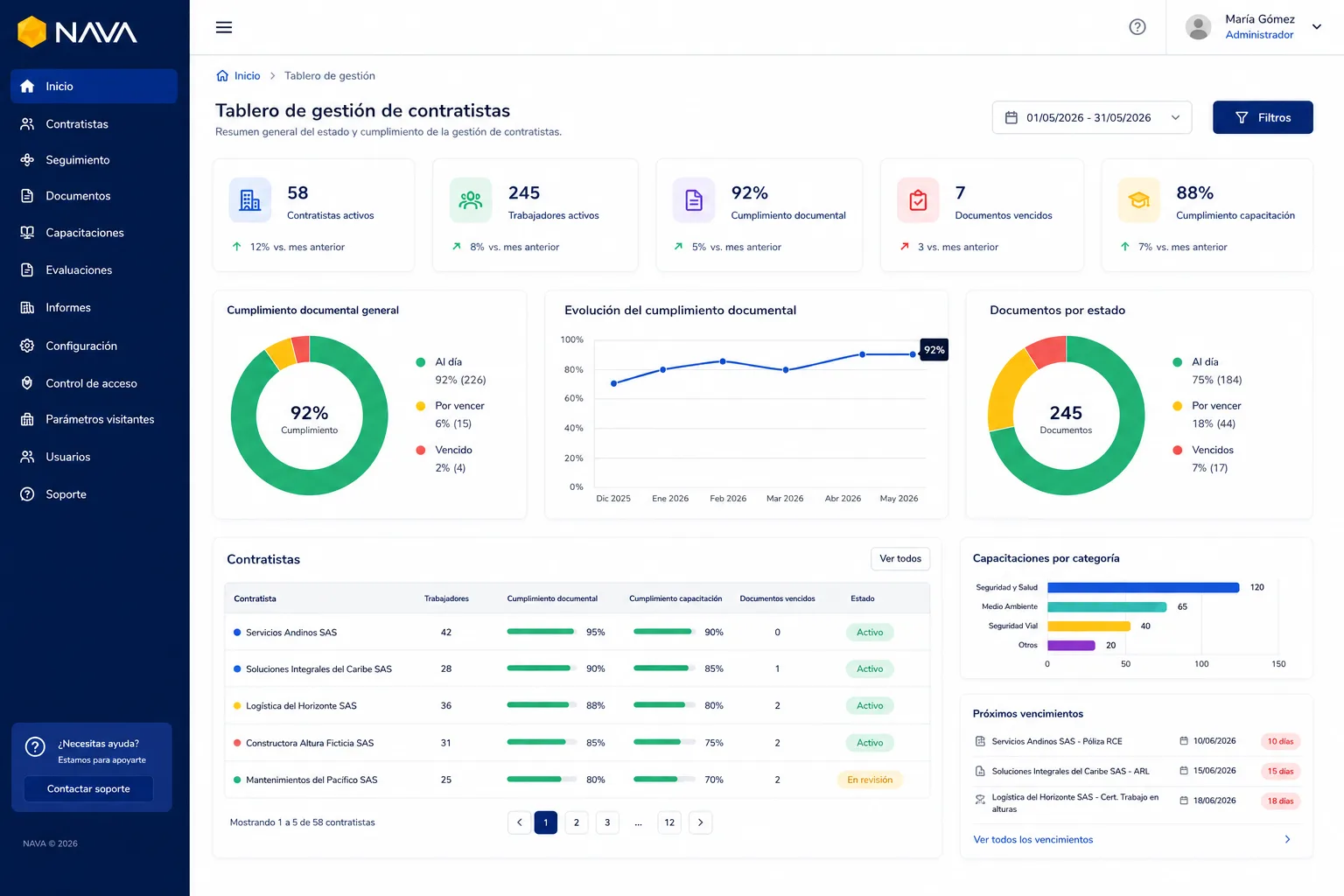
    NAVA contractor management dashboard, with document compliance, documents by status, the contractor list, and upcoming expirations
    A single view to know who complies, who’s pending, and who’s cleared.
  6. Control — Compliance reaches the access point

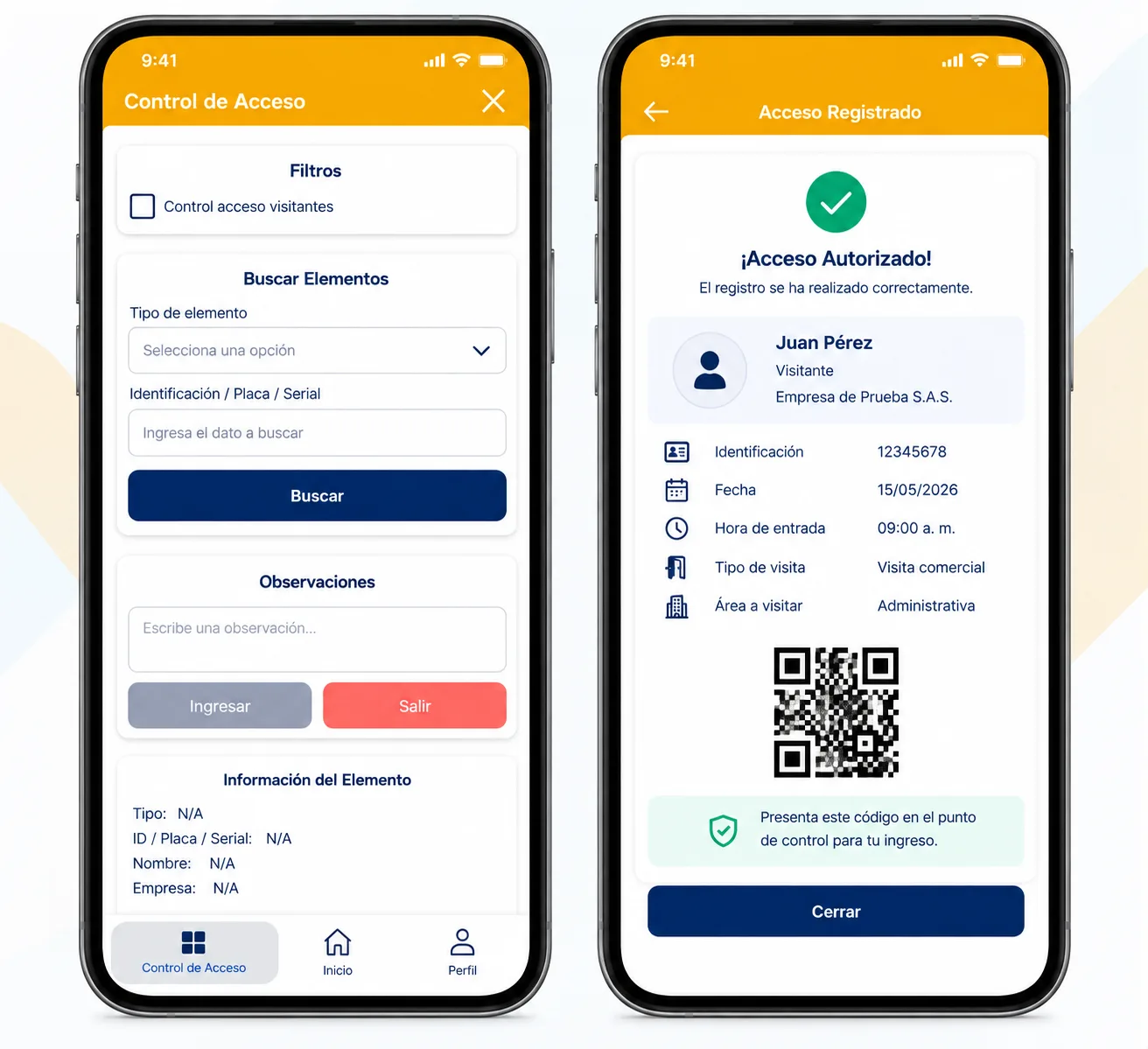
    At the gatehouse, NAVA lets you look up by ID number, license plate, serial number, or QR code and check the status of the person or element.

    When the conditions the company defines aren’t met, the system can restrict access according to the configured rules.

    Every exception or authorized entry is logged to maintain traceability.

    • Mobile app
    • QR
    • Real-time validation
    Access control lookup in NAVA: you enter the ID number and the system responds “Acceso permitido: contratista al día” (access granted, contractor up to date) with the status, ID number, name, the third party’s company name, and the authorized activity
    The information validated in NAVA is the same information that supports decisions at the access point.
  7. Monitor — Qualification continues. Performance matters too

    The relationship with a third party doesn’t end when it meets the requirements or gets authorization to enter.

    NAVA lets you keep track of qualification conditions, manage expirations and training, and periodically evaluate supplier and contractor performance.

    That way, the company gets a more complete view to identify noncompliance, opportunities for improvement, and how its suppliers behave throughout the relationship.

    • Expiration alerts
    • Supplier performance evaluation
    • Reports and traceability
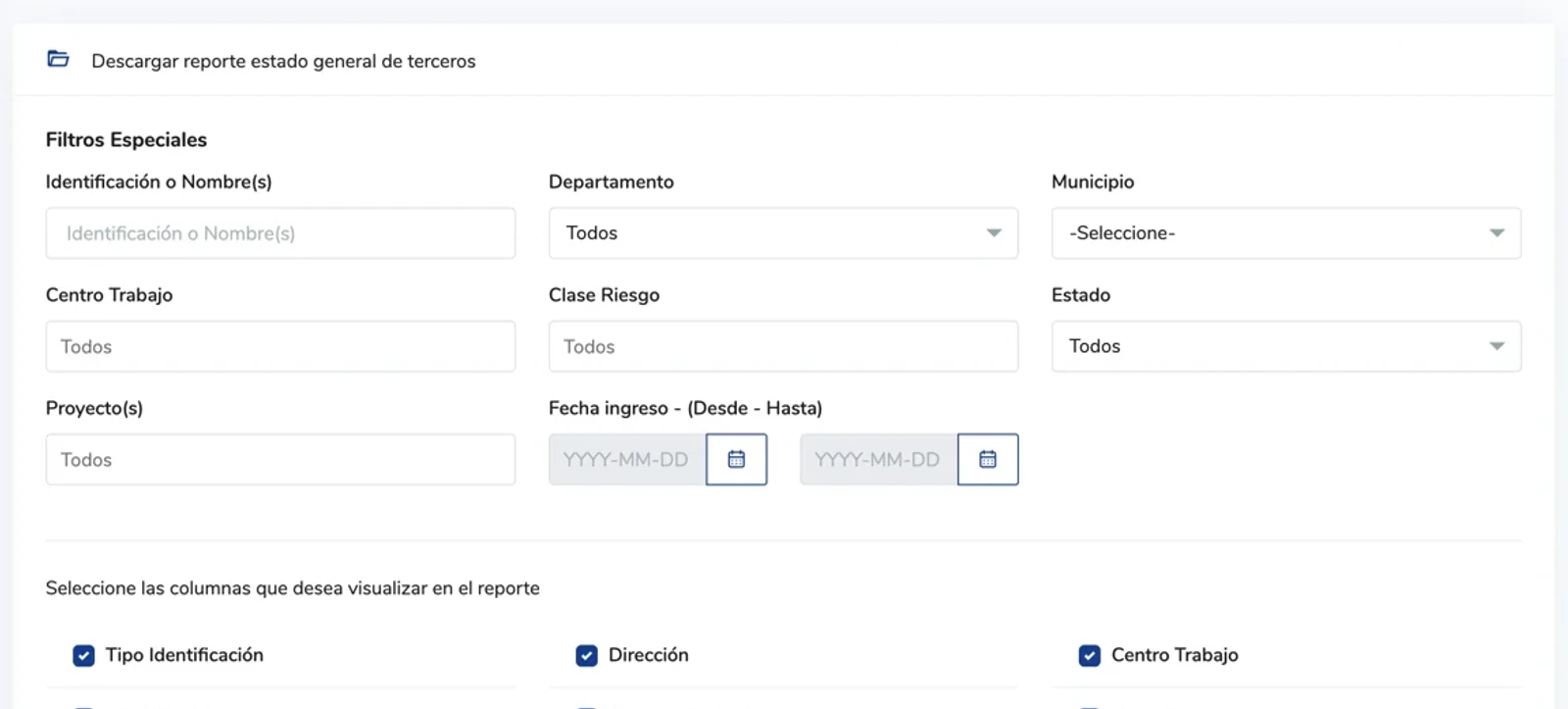
    Third-party status report in NAVA, with its filters and the compliance columns for each third party
    Monitor your suppliers’ compliance and performance to make decisions with information and traceability.

The NAVA ecosystem

One cycle. Three solutions. One single control.

NAVA connects the processes you need to qualify, train, and control the people who interact with your operation. Each solution can work on its own or integrate with the others to support the entire cycle, from meeting requirements to control and follow-up.

The platform on screen

The dashboard that answers for you

Each profile gets access to what applies to it: your team checks compliance by third party, the contractor reviews which documents are missing and which activities they’re cleared for, and the gatehouse gets a single answer—whether the person can enter or not.

Industries

Built for industries with critical operations and high contractor turnover

Each industry demands different document requirements and its own entry pace. A plant shutdown isn’t managed like a port shift. The document requirements matrix is configured for each case.

  1. 01

    Energy and Oil & Gas

    Document traceability by activity type, 24/7 gatehouse access control, support for audits by clients and oversight bodies, and automatic blocking when contractor personnel in maintenance, operational shutdowns, and technical services have expired documents.

    Decree 1072 of 2015 · Resolution 0312 of 2019 · ARL by risk class

    See the industry
  2. 02

    Mining

    Rotating contractor personnel in 24/7 operations, with document requirements by risk class, a valid occupational medical exam, and specific training. Automatic access blocking when documentation has expired.

    Decree 1072 of 2015 · Resolution 0312 of 2019 · applicable mining regulations

    See the industry
  3. 03

    Construction and Civil Works

    Subcontractor prequalification by work front, ARL and EPS enrollment control, insurance policy validation, and document traceability by project, with requirements defined by activity type.

    Decree 1072 of 2015 · Resolution 0312 of 2019 · joint labor liability

    See the industry
  4. 04

    Industry and Manufacturing

    Bulk validation of contractors for maintenance, operational shutdowns, and specialized technical services. Requirements by activity type, with an online induction renewed automatically for recurring personnel.

    Decree 1072 of 2015 · Resolution 0312 of 2019 · ARL by industrial risk class

    See the industry
  5. 05

    Logistics and Transportation

    Document control for drivers, vehicles, and machinery. The element concept covers all three, so a vehicle without valid SOAT is use-restrictive just as a person without ARL coverage is entry-restrictive.

    Decree 1072 of 2015 · Resolution 0312 of 2019 · mandatory vehicle documentation

    See the industry
  6. 06

    Ports and High-Volume Operations

    Document control for carriers, logistics operators, and technical staff entering port terminals. Advance validation so the daily volume of entries doesn’t become an operational bottleneck.

    Decree 1072 of 2015 · Resolution 0312 of 2019 · applicable port regulations

    See the industry
  7. 07

    Free Trade Zones

    Its own entry control regime and high third-party turnover. General perimeter entry requirements defined by the zone operator, with a searchable record of entries and exits.

    Decree 1072 of 2015 · free trade zone regime

    See the industry
  8. 08

    Multi-Site Companies

    A single document requirements matrix for the whole company. Each site and each project has its own people in charge, and management views consolidated compliance calculated with the same rule.

    Decree 1072 of 2015 · Resolution 0312 of 2019

    See the industry

Why NAVA

Turn compliance into operational control

  1. 01

    Specialized knowledge turned into technology

    NAVA was born from experience in management, compliance, OHS (occupational health and safety), and the operations of companies that need to control people, third parties, and critical processes. We don't build technology and then look for a problem to solve: we turn our clients' real, recurring problems into digital solutions.

  2. 02

    One cycle to manage qualification

    NAVA connects identification, requirements, verification, training, qualification, access, and follow-up in a single ecosystem. Information no longer sits scattered across emails, Excel files, folders, and standalone systems: each stage feeds the next and keeps traceability over operating conditions.

  3. 03

    People, third parties, and assets under control

    Control doesn't end with one person or one document. NAVA lets you manage the conditions tied to workers, contractors, suppliers, visitors, vehicles, and machinery, according to the needs of each operation. The goal is to know what's cleared, what's pending, and what needs attention.

  4. 04

    Artificial intelligence applied to compliance

    NAVA uses artificial intelligence to make the review of information and documents more efficient. The technology helps identify relevant data, dates, inconsistencies, and possible noncompliance, while the rules your company configures and responsible judgment keep control over the final decision.

  5. 05

    Training that reaches people

    Training is part of control, too. With NAVA Skills, workers and third parties can receive content, answer quizzes, and generate evidence directly on WhatsApp. Less friction to train, and easier follow-up and proof of compliance.

  6. 06

    From compliance to supplier performance

    Meeting the requirements is only the beginning. NAVA lets you track qualification conditions and evaluate supplier and contractor performance, generating information to identify noncompliance and opportunities for improvement, and to make decisions about your relationships with third parties.

  7. 07

    Technology that evolves with your operation

    NAVA evolves based on the needs we identify in our clients' operations. We add automation, artificial intelligence, new channels like WhatsApp, and new capabilities so technology adapts to people, not the other way around.

Regulatory compliance

One system for every regulatory framework your company must comply with

The document requirements matrix doesn't come with a predefined regulation. Your company defines which documents to require, from whom, with what validity period, and who approves them, whether that serves the requirements of Decree 1072 of 2015 (Colombia's labor regulation, which includes occupational health and safety), the HSE demands of a client or a regulator, or the counterparty due diligence that your compliance program requires.

  • Occupational health and safety — Decree 1072 of 2015

    Enrollment with an ARL (Colombia's occupational risk insurer) and an EPS (health insurer), occupational medical exams, training by risk class, and induction configurable as entry-restrictive. The contracting employer's obligations regarding the OHS management system (SG-SST) of each third party that enters its operation.

  • HSE requirements from operator clients

    The document requirements matrix that your clients or regulators require of you, replicated down to your own contractors. Each demand becomes a requirement with a validity period, an approver, and review criteria.

  • SAGRILAFT and counterparty due diligence

    The counterparty due diligence that the SAGRILAFT program (Colombia's anti-money-laundering and counter-terrorist-financing risk system) requires is, operationally, a document requirements matrix with an approver and traceability for every decision. Configure which documents to request from each supplier, with what validity period, and who approves them.

    See the SAGRILAFT guide →
  • Your own contractual requirements

    Insurance policies, technical certifications, RUT (Colombian tax registration), chamber of commerce certificate, and any requirement your purchasing team defines, configurable as a contract-restrictive document.

Technology and information security

Where your third parties' data lives

NAVA safeguards ID documents, social security enrollment records, and contact details for hundreds of people who aren't your company's employees. That creates specific obligations under Law 1581 of 2012 (Colombian data protection law), and this is how they're met.

  • 01

    100% web-based SaaS

    No installation and no servers of your own. Access from a browser and from the NAVA mobile app.

  • 02

    Cloud infrastructure on AWS and a TIER 3 data center

    No in-house servers for your company to manage.

  • 03

    Role-based access control

    Profiles with granular permissions for each menu option; each user accesses only what applies to them.

  • 04

    Audit logs

    Every creation and edit is recorded with who made it and when. Document decisions are traceable.

  • 05

    Law 1581 of 2012

    Every third party and every visitor explicitly accepts the personal data processing policy before uploading information.

Operational impact

What changes when compliance becomes control

Managing people and third parties shouldn't mean chasing documents, updating matrices, and cross-checking information by hand to know who can operate. NAVA connects people, requirements, training, qualification, access, and follow-up in a single cycle, so your team goes from managing scattered information to making decisions with up-to-date, traceable information.

The six problems NAVA transforms

  1. 01
    Scattered information People, suppliers, requirements, training, access, and evaluations spread across different files and channels.
  2. 02
    Manual processes Registration, data uploads, validation, alerts, and follow-up that take time and depend on repetitive tasks.
  3. 03
    Uncertainty about qualification Difficulty knowing quickly who is cleared, what meets the requirements, what's pending, and why.
  4. 04
    Disconnected training Training managed separately that requires individual follow-up to prove participation and results.
  5. 05
    Access separate from compliance Entry control operates independently from the information about people and their qualification status.
  6. 06
    Little follow-up after qualification Expirations, training, compliance, and supplier performance that aren't always monitored continuously.
Traditional management NAVA
Information spread across files and different channels Information connected in a single ecosystem
Manual tracking of documents and expirations Automated tasks and alerts
Hard to know who is cleared Visible, traceable qualification status
Training and access managed separately Training connected to follow-up
Supplier evaluation disconnected from compliance Compliance + supplier performance
Evidence rebuilt by hand for an audit Traceability across the entire qualification and control cycle

Plans

Choose the solutions your operation needs

NAVA adapts to the way your company operates. You can start with one solution and expand the ecosystem as your needs grow. Each solution can be contracted independently or integrated to connect the entire qualification and control cycle.

Third-party qualification and management

Plans based on the number of active elements you manage. Includes the capabilities you need to register, verify, qualify, and track people, suppliers, and contractors.

Two options: Basic, for teams that handle validation themselves, and Plus, which adds support from the NAVA back office, with our team reviewing the documentation.

Free 30-day trial

Visitor access control

Plans based on the number of elements managed. It can be activated on its own or integrated with NAVA 360 to connect qualification with access control.

Training via WhatsApp

Plans based on the number of people to train. All of them include training management, reminders, certificates, and tracking from the dashboard.

Start with the solution you need and build your NAVA ecosystem as your operation grows. You'll receive a custom pricing proposal after the demo, based on the scope and volume of your operation.

See plan details →

Frequently asked questions

What purchasing directors and OHS leaders ask us most

Do I need to contract all three solutions?

You don't need to contract all of NAVA to get started. Each solution works independently, and you can integrate them when you need to. Start by solving your operation's most important challenge and expand the ecosystem as your needs grow.

Each solution addresses a different moment:

  • NAVA 360: when you need to manage and qualify third parties.
  • NAVA Skills: when you need to train and track workers and third parties.
  • NAVA ID: when you need to control visitor access.
Who uploads the information, my team or the third party?

Third parties can manage their own information directly in NAVA. They receive their access, accept the data processing policy, and register the relevant people, vehicles, and machinery. They can also use templates for bulk uploads. Your team stops chasing and typing in information and focuses on reviewing and handling exceptions.

Is validation done by a person or by artificial intelligence?

NAVA combines technology, business rules, and artificial intelligence to make verification more efficient. Your company defines the criteria, and when human judgment is needed, a person can review and record the decision. You can also rely on the NAVA back office to support validation, depending on the service you contract. Finally, you can purchase an add-on package for AI pre-approvals.

Can NAVA integrate with the access control systems we already have?

NAVA can operate from day one using its own lookup and control mechanisms. Integration with existing physical access control systems is evaluated case by case during the technical assessment, based on the installed technology, brand, and model.

What happens if someone needs to enter and doesn't meet one of the requirements?

NAVA lets you manage exceptions when your company authorizes them. The entry can be logged with a record of who authorized it, when, and on what grounds. That way, the exception doesn't disappear from the process: it's traced for later reference and follow-up.

How much does NAVA cost?

The price depends on the solution and the scope of your operation. NAVA 360 and NAVA ID can be configured based on the volume of elements you manage, while NAVA Skills is structured according to the number of workers. Once we understand your operation, we'll send you a custom pricing proposal.

Does NAVA comply with Law 1581 of 2012, Colombia's personal data protection law?

NAVA includes mechanisms for managing the processing of personal data, including acceptance of the corresponding policy and controls over access to information. The platform has profiles and permissions to manage access, and it logs relevant actions to maintain traceability. Implementation and configuration should align with the data protection policies and obligations of each company.

How long does it take to implement NAVA?

It depends on the scope of the solution, the amount of information that needs to be configured, and how well defined your company's processes and requirements are. During implementation, work sites, activities, requirements, users, and other operating conditions are configured as applicable. The timeline is defined during the initial assessment.

Demo

See how NAVA can work in your operation

Get to know NAVA through a scenario close to your reality. We'll show you how you can manage requirements, verify information, train people, qualify third parties, control access, and track compliance and performance from a single ecosystem. At the end, we'll identify the solutions you actually need and the right scope for your operation.

  • Technology developed in Colombia
  • Free 30-day trial
  • Cloud infrastructure on AWS
  • Personal data protection and management
  • Human technical support in Spanish