
Industries · Energy and Oil & Gas
Contractor management in the energy and oil & gas industry
During a plant turnaround, dozens of contractors who aren’t there the rest of the year come in over a few days, each with its own personnel, vehicles, and equipment. NAVA validates that documentation before the entry window and leaves the gatehouse with a single lookup.
Your company answers to clients or oversight bodies for your own contractors’ documents. Every requirement, every approval, and every entry is recorded with a responsible person and a date.

Critical moment in energy and oil & gas
The plant turnaround window
- Who comes in
- Maintenance and technical services contractors, carriers
- Elements under control
- People · vehicles · machinery
- Answer at the gatehouse
- Cleared for entry: yes or no
Context
Who controls whom in an energy operation
A plant, a terminal, or a production field runs on third parties. Maintenance, instrumentation, scaffolding, lifting, and transportation are carried out by contractors who arrive with their own personnel, vehicles, and equipment.
None of those people are your direct employees, and your company is accountable for what happens to them while they’re at the plant. Further up the chain, oversight bodies ask you for evidence of that control, with dates and responsible people.
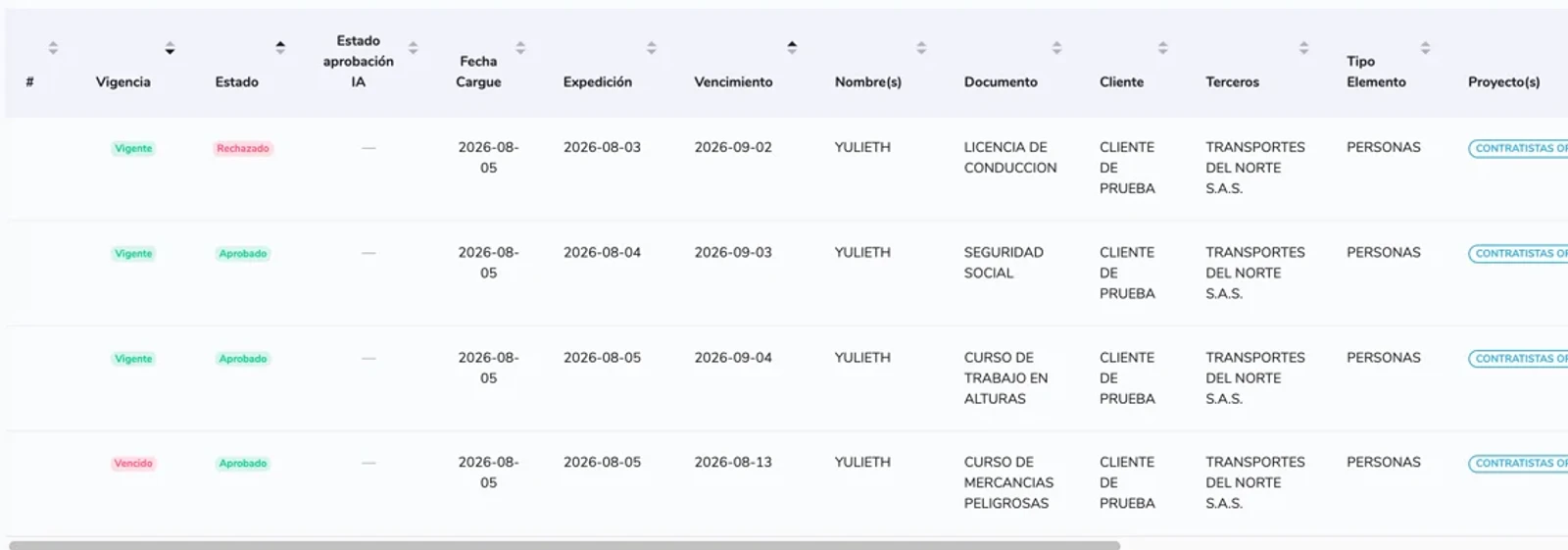
NAVA manages the whole chain: the requirements you define, the files the contractor uploads, the review by your team or the back office, the validity periods the system calculates, and the gatehouse lookup.
The problem
What makes contractor control hard in energy and oil & gas
Situations your team will recognize, and what happens today when control depends on a spreadsheet and on the memory of whoever is at the door.
-
The turnaround concentrates entry
Dozens of contractors come in within a window of days. The document validation that, in normal operations, is spread over months piles up into a single week, and each company arrives with new personnel, equipment that hadn’t come before, and documents issued the day before.
The line forms at the gate on the first day of the shutdown, and the decision to let someone in or not is made by whoever is at the gatehouse.
-
Audits by oversight bodies or clients go up the chain
The operator audits your company for the documentation of your company’s contractors. The evidence they ask you for is exactly what you should have required from them, with dates and responsible people.
Without a record you can look up, that evidence is rebuilt by hand, going through emails and folders from months back.
-
Technical personnel who return between turnarounds
The welder who came for the last turnaround comes back for the next one. Months passed in between, and their certification, medical exam, or enrollment may have expired in the meantime.
The review happens when someone remembers to look, and familiarity with the contractor is what ends up authorizing entry.
-
Different activities, different requirements
The same contractor can have personnel doing different jobs: instrumentation at a terminal, lifting at a field operation. Each activity has its own requirements, and the confined spaces certificate matters in one case and not in the other.
A single list of documents doesn’t reflect both realities, and it ends up requiring too much on one side and too little on the other.
-
Equipment and vehicles with their own validity periods
Contracted machinery has inspection certificates with their own expiration date, independent of the documentation of whoever operates it.
The operator may be up to date and the equipment not, and person-based control doesn’t catch it.
Document requirements matrix
The documents your operation requires
The matrix turns your company’s procedure into rules the system applies: which element each document is required for, under which activity, with what validity period, who approves it, and what gets blocked when it expires.
- Entry The person or vehicle can’t enter while the document is expired or rejected.
- Use The equipment or machinery is disabled from operating.
- Contract It affects the continuity of the relationship with the contractor company.
| Document | Applies to | Blocks | Operational note |
|---|---|---|---|
| Current enrollment with an ARL (Colombia’s occupational risk insurer), with risk class | People | Entry | The risk class must match the activity they’ll perform, not that of the master contract |
| Current enrollment with an EPS (health insurer) and a pension fund | People | Entry | |
| Valid occupational medical exam | People | Entry | With the emphases the activity requires |
| Work-at-heights certificate | People | Entry | Activities more than two meters above floor level |
| Technical certifications for the activity | People | Entry | Welding, confined spaces, lifting, depending on the work performed |
| Equipment inspection certificate | Machinery | Use | Equipment without a valid certificate is disabled from operating |
| SOAT (Colombia’s mandatory vehicle insurance) and technical-mechanical inspection | Vehicles | Use | |
| Civil liability insurance policy | Company | Contract | |
| Site HSE induction | People | Entry | Without it, the person isn’t cleared, even if everything else is up to date |
Each requirement is configured once with its validity period, its approver, and its review criteria. Entry override is available as an exception, with a named person responsible and a justification.
How it works
Who does what, from onboarding to the gatehouse
Your team manages the relationship, the third party uploads their information, and NAVA applies the rules throughout the cycle. These are the five stages in energy and oil & gas.
- 01
Your team
Onboarding
The contractor is linked to the contract and to the activities it will perform during the turnaround. The activity determines which documents are required of each of its people and each piece of its equipment; work sites classify it for reporting.
- 02
NAVA
Requirement assignment
The system applies the matrix to each person, vehicle, and piece of machinery according to the assigned activity. Two people from the same company can end up with different requirements if they do different jobs.
- 03
The contractor
Document upload
The contractor company logs in to its own portal, creates its people, vehicles, and machinery, and uploads the files. Large batches are uploaded with an Excel template.
- 04
Your team or the NAVA back office
Validation
The reviewer opens the file along with the dates and the criteria your company defined, and approves, rejects, or leaves it pending.
- 05
Gatehouse
Entry lookup
At the gate, the lookup is by ID number, license plate, serial number, or QR code from the app. The answer is cleared for entry, yes or no, and when it’s no, the reason is right there on screen.
Scenario
The week before the turnaround
The validation work happens before the entry window opens. Your team checks progress by contractor company: how many elements are linked, how many documents have already been approved, which ones expire within the window, and which ones were rejected and with what comment.
With that view, you decide where to push: the scaffolding company is halfway through its documentation and comes in four days from now. What the gatehouse does on the first day of the shutdown is look things up, not go through folders.
Results
What changes when control no longer lives in a spreadsheet
Four concrete changes to day-to-day work in energy and oil & gas. You can see each one in detail on the page of the solution that carries it out.
-

Expiration no longer depends on someone checking
-

The gatehouse decides without calling anyone
-
Evidence doesn’t have to be rebuilt
-

Your administrative team reviews instead of typing
The platform
Which solutions are involved in this industry
NAVA is three solutions on the same platform. This is the role each one plays in an operation like yours.

The main solution: the document requirements matrix for turnaround contractors, validation against criteria, expiration control, and entry lookups for people, vehicles, and machinery.
See NAVA 360 →
The manufacturer’s technician, the operator’s auditor, or the institutional visit that comes only once: self-registration through a link or QR code, host pre-approval, and induction before reaching the gate.
See NAVA ID →
Training for your own staff over WhatsApp, with two-minute micro-lessons, an assessment in the chat, and a PDF certificate.
See NAVA Skills →All three share one platform and database and are contracted separately. Most operations in this industry start with NAVA 360, which is where the volume of third parties is.
Regulatory framework
Applicable regulations and how they translate into documents
NAVA doesn’t interpret the regulations: it manages the documents your company uses to show it has complied with them. Your procedure defines the requirements, not the software.
| Framework | What it requires | How it shows up in the document requirements matrix |
|---|---|---|
| Decree 1072 of 2015 | Obligations under the OHS (occupational health and safety) management system (SG-SST), including the hiring company’s obligations toward third parties who enter its operation | ARL, EPS, and pension enrollments, occupational medical exams, and site induction |
| Resolution 0312 of 2019 | Minimum SG-SST standards by company size and risk class | Requirements differentiated by risk class and by activity |
| Resolution 4272 of 2021 | Minimum safety requirements for work at heights, more than two meters above floor level | Work-at-heights certificate as an entry-restrictive document |
| HSE requirements from clients or oversight bodies | They aren’t regulations, but in practice they’re the strictest requirement in the chain | Configured as your own requirements, with their validity period and their approver |
Frequently asked questions
Questions about third-party control in Energy and Oil & Gas
Does it work for a plant turnaround, where everything is concentrated in a few days?
That’s where it shows the most. Document validation for the turnaround contractors happens beforehand, with the lead time your company configures, and on entry day the gatehouse only looks things up. The bottleneck is no longer at the gate.
Our clients or oversight bodies audit us for our contractors’ documents. Can we prove that?
Yes. Every required document, every approval, every rejection with its comment, and every entry are recorded with a responsible person and a date. When the operator asks for evidence of the control you exercised, you look it up and export it to Excel.
Can we require something different at the terminal and at the field operation?
Requirements are configured by activity type, so the same contractor can have personnel cleared for one job and not for another. You don’t define different requirements by location or by work site.
What about contracted machinery?
It’s an element with its own document requirements matrix. Its inspection certificate has its own validity period, and when it expires, the equipment is disabled from operating even if the person running it is up to date.
Who reviews the contractors’ documents?
On the Basic plan, your company’s team reviews them. On the Plus plan, the NAVA back office reviews them within 24 hours at most. Both use the criteria your company configured in the document requirements matrix. See plans and pricing.
How do you upload hundreds of workers before a turnaround?
The contractor uses an Excel template to create its people, vehicles, or machinery in a single bulk upload, and then uploads each one’s files.
Does NAVA need a different setup for each industry?
The document requirements matrix is configured with your company’s requirements, and those requirements change from one industry to the next. The system is the same: what you configure are the documents, validity periods, approvers, and which document blocks what.
Demo
See NAVA with the requirements of your energy operation
We set up a scenario with the documents your company requires today, the activities in your operation, and the lookup your gatehouse would do. You leave with a written price proposal.
- Colombian software
- 30-day trial
- OHS validation available
- Support in Spanish