
Cleared for entry
- Driver’s license Valid until Mar 14, 2028
- ARL, EPS, and pension Valid
- Medical exam Expires in 21 days
Industries · Logistics and Transportation
The driver has ARL coverage (Colombia’s occupational risk insurance) and a driver’s license; the vehicle has its SOAT (Colombia’s mandatory vehicle insurance) and its technical-mechanical inspection. These are two sets of documents that expire on different dates, and both have to be valid for that trip to happen.
In NAVA, the vehicle is a controlled element with its own document requirements. If the SOAT has expired, the vehicle is disabled from operating even if the driver is up to date, and the gatehouse sees it when it looks up the license plate.

Critical moment in logistics and transportation
The gate, with the truck waiting
Context
A distribution center or a transportation operation receives third-party vehicles every day. Behind each entry are two sets of documents that have nothing to do with each other: the driver’s and the vehicle’s.
Each one expires on its own schedule, and the combination changes every day. The same driver may come in a different vehicle, and the same vehicle with a different driver.
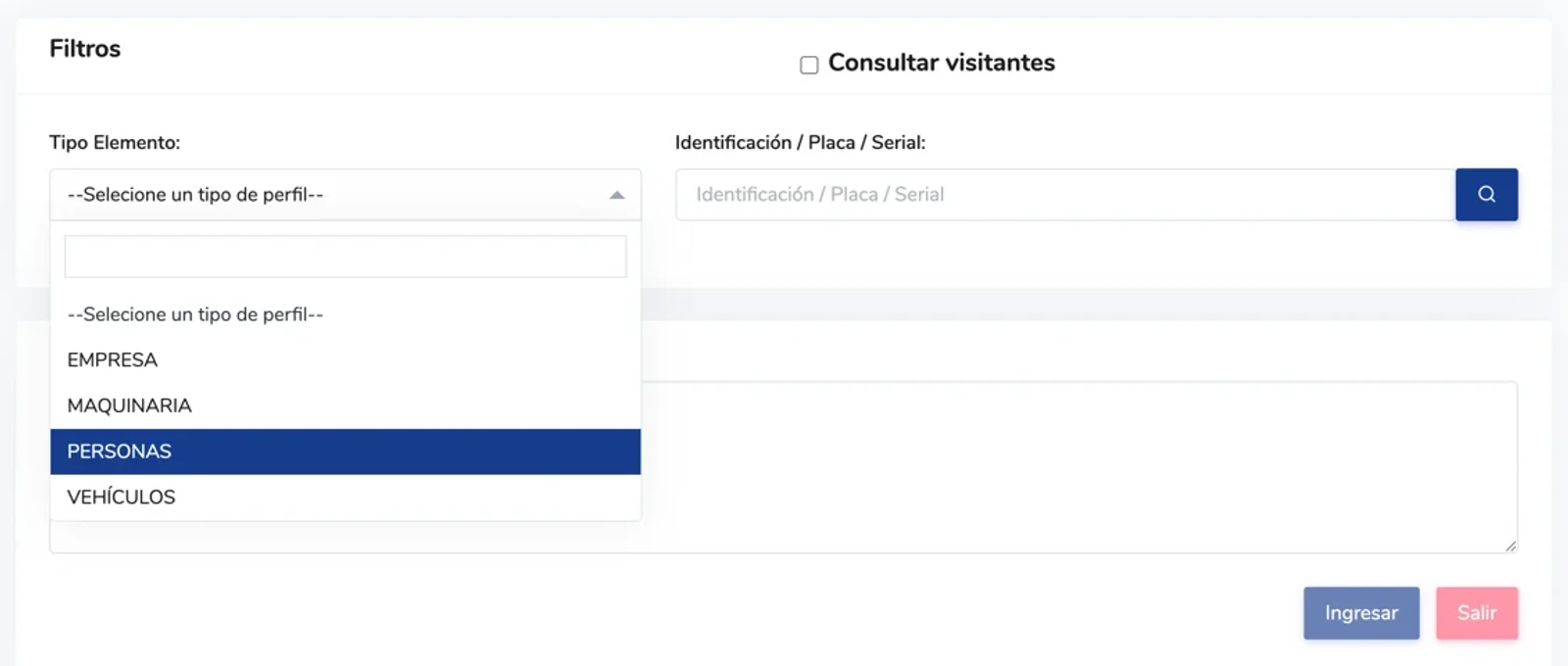
In NAVA, both are elements with separate matrices. At the gate, you look up an ID number or a license plate, and the system answers for both.
The problem
Situations your team will recognize, and what happens today when control depends on a spreadsheet and on the memory of whoever is at the door.
The driver’s and the vehicle’s are independent: one is renewed in March and the other in August, and neither one flags the other.
Usually only one gets checked, and if the other has expired, that entry shouldn’t happen.
Today the carrier sends the tractor-trailer with one driver and tomorrow with another; yesterday’s driver shows up today in a different vehicle.
A control tied to the person says nothing about the vehicle coming in, and a list of license plates says nothing about who’s driving.
Nobody goes through folders with a tractor-trailer stopped on the truck scale and two more behind it. The check has to fit in the time a single lookup takes.
If the control doesn’t answer in seconds, it gets skipped, and the truck is let in so the dispatch isn’t held up.
Companies with one or two vehicles and no administrative staff: the person who drives is the one who handles the paperwork.
The burden of collecting and updating documents falls on your team, which ends up chasing people who are on the road.
Contracted forklifts, cranes, and lifting equipment have inspection certificates with their own validity period, independent of who operates them.
The operator may be cleared and the equipment not, and no person-based control catches it.
Document requirements matrix
The matrix turns your company’s procedure into rules the system applies: which element each document is required for, under which activity, with what validity period, who approves it, and what gets blocked when it expires.
| Document | Applies to | Blocks | Operational note |
|---|---|---|---|
| Valid driver’s license | People | Entry | The license category must match the vehicle they’ll drive |
| Current enrollment with an ARL, EPS (health insurer), and pension fund | People | Entry | |
| Valid occupational medical exam | People | Entry | With the emphases required for a driving position |
| Activity certifications | People | Entry | Handling of hazardous materials or others, depending on the cargo |
| Valid SOAT | Vehicles | Use | Without it, the vehicle shouldn’t operate |
| Technical-mechanical and emissions inspection | Vehicles | Use | |
| Vehicle registration card | Vehicles | Use | |
| Contractual and non-contractual civil liability insurance policy | Company | Contract | As your operation requires |
| Inspection certificate for lifting or handling equipment | Machinery | Use | Contracted forklifts, cranes, and equipment |
| Site induction | People | Entry | With a configurable validity period |
Each requirement is configured once with its validity period, its approver, and its review criteria. Entry override is available as an exception, with a named person responsible and a justification.
How it works
Your team manages the relationship, the third party uploads their information, and NAVA applies the rules throughout the cycle. These are the five stages in logistics and transportation.
Your team
The carrier company is linked to the contract and to the activities it performs. That’s where you define which company documents it must provide and which ones affect the continuity of the contract.
The carrier
The carrier creates its drivers and vehicles (each with its license plate) from its own portal and uploads each one’s documents. Large fleets are uploaded with an Excel template.
NAVA
The system applies one matrix to people and another to vehicles, with independent validity periods. Contracted machinery gets its own.
Your team or the NAVA back office
The reviewer approves, rejects with a comment, or leaves it pending. The rejection reaches the carrier’s portal with the reason, with no calls or emails.
Gatehouse
The guard types in the license plate or the ID number, or scans the QR code on the ID badge, and the system answers for the driver and for the vehicle.
Scenario
A tractor-trailer pulls up. The gatehouse types in the license plate, and the screen answers for both elements at once: the driver, cleared for entry, with a valid license and current enrollments; the vehicle, disabled from operating, because its SOAT expired on August 2.
The decision is made with the truck still at the gate and without opening a folder. If the operation needs to let it in, an entry override requires who authorizes it and why.
Cleared for entry
Disabled from operating
Results
Four concrete changes to day-to-day work in logistics and transportation. You can see each one in detail on the page of the solution that carries it out.



The platform
NAVA is three solutions on the same platform. This is the role each one plays in an operation like yours.

Separate document requirements for drivers, vehicles, and machinery, with independent validity periods and license plate lookup at the gate.
See NAVA 360 →
Occasional carriers and one-off visits to the distribution center: self-registration through a link or QR code, and pre-approval.
See NAVA ID →
Training over WhatsApp for drivers, taken from their phone without installing anything.
See NAVA Skills →All three share one platform and database and are contracted separately. In transportation, NAVA Skills makes sense early on because the driver is on the road and the training arrives through the same channel they already use to communicate.
Regulatory framework
NAVA doesn’t interpret the regulations: it manages the documents your operation uses to show it verified, with a responsible person and a date on every decision.
| Framework | What it requires | How it shows up in the document requirements matrix |
|---|---|---|
| Decree 1072 of 2015 | The hiring company’s obligations under its OHS (occupational health and safety) management system (SG-SST) toward third parties who enter its operation | ARL, EPS, and pension enrollments, medical exams, and site induction |
| Resolution 0312 of 2019 | Minimum SG-SST standards by company size and risk class | Differentiated requirements for driving and handling activities |
| Mandatory vehicle documentation in Colombia | SOAT, technical-mechanical and emissions inspection, and a driver’s license of the corresponding category | SOAT and inspection as use-restrictive for the vehicle; license as entry-restrictive for the person |
Frequently asked questions
Both, and separately. A vehicle is an element with its own document requirements matrix: SOAT, technical-mechanical inspection, vehicle registration card, and whatever your operation requires, each with its validity period.
The gatehouse looks up an ID number or a license plate, or scans the QR code on the ID badge, and the system answers with the status calculated at that moment. There are no folders to open and no one to call.
The person is cleared for entry and the vehicle is disabled from operating. They’re two different statuses because they’re two different elements.
No. Each driver and each vehicle is registered as an independent element, with its own documents, so any combination is evaluated without uploading anything again.
Yes. Requirements are assigned by activity, so a driver who transports hazardous materials can have requirements another driver doesn’t.
The carrier logs in to its own portal, uploads its documents, and sees what’s missing and what was rejected, with the reviewer’s comment. It doesn’t need administrative staff to keep it up.
The document requirements matrix is configured with your company’s requirements, and those requirements change from one industry to the next. The system is the same: what you configure are the documents, validity periods, approvers, and which document blocks what.
Demo
We set up both document requirements matrices (person and vehicle) and the license plate lookup your gatehouse would use. You leave with a written price proposal.