
Industries · Ports and High-Volume Operations
Contractor and visitor control at port terminals
Every day, carriers, logistics operators, technical staff, and visitors enter a terminal. There’s no room for document checks at the gate: there’s only time to look someone up.
NAVA moves all validation to before entry. Recurring contractors are managed with their document requirements matrix and occasional visitors with self-registration and pre-approval, and the gatehouse looks up both in one place.

Critical moment in ports and high-volume operations
The daily entry peak
- Who comes in
- Carriers, logistics operators, technical staff, visitors
- Elements under control
- People · vehicles · machinery
- Answer at the gatehouse
- Cleared for entry: yes or no
Context
Two kinds of third parties coming through the same gate
A terminal moves people all day, and of two different kinds. The recurring ones: logistics operators, work crews, carriers, equipment maintenance. And the occasional ones, who come only once.
Recurring third parties are held to a full matrix, and their validity periods are tracked month by month. Occasional ones are asked for less, but before they arrive: who receives them, which documents they provide, and which induction they complete.
What can’t have two paths is the gate. Both flows live on the same platform, and the gatehouse looks things up in one place.
The problem
What makes entry control hard at a terminal
Situations your team will recognize, and what happens today when control depends on a spreadsheet and on the memory of whoever is at the door.
-
Daily volume overwhelms the procedure
A procedure that works with ten entries falls apart with three hundred. What would be an administrative nuisance in another operation forms a line on the access road here.
Verification becomes the operation’s bottleneck, and it ends up being skipped so as not to stop it.
-
Recurring and occasional third parties coexist
The logistics operator comes every day and the supplier’s technician comes once, with completely different requirements and expectations.
If each has its own procedure, the gatehouse ends up deciding which one applies, on the spot and with the line waiting.
-
High turnover of third-party staff
The crew on one job isn’t the crew on the next, and the logistics operator changes staff depending on the shift and the vessel.
A company-level control says nothing about who’s coming in today, which is exactly what you need to know.
-
Round-the-clock operation
The vessel doesn’t wait. Jobs happen before dawn, on weekends, and on holidays, when the administrative staff isn’t there.
Any control that depends on a phone confirmation stops existing outside office hours.
-
The record is requested afterward
After an audit or an incident, you have to answer who came in, when, with what authorization, and for which job.
With paper sign-in sheets or daily files, that answer takes hours and isn’t always complete.
Document requirements matrix
The documents your operation requires
The matrix turns your company’s procedure into rules the system applies: which element each document is required for, under which activity, with what validity period, who approves it, and what gets blocked when it expires.
- Entry The person or vehicle can’t enter while the document is expired or rejected.
- Use The equipment or machinery is disabled from operating.
- Contract It affects the continuity of the relationship with the contractor company.
| Document | Applies to | Blocks | Operational note |
|---|---|---|---|
| Current enrollment with an ARL (occupational risk insurer), EPS (health insurer), and pension fund | People | Entry | |
| Valid occupational medical exam | People | Entry | |
| Activity certifications | People | Entry | Equipment operation, lifting, cargo handling, depending on the job |
| Work-at-heights certificate | People | Entry | Activities more than two meters above floor level |
| Valid driver’s license | People | Entry | Carriers who enter the terminal |
| SOAT (mandatory vehicle insurance) and technical-mechanical inspection | Vehicles | Use | |
| Equipment inspection certificate | Machinery | Use | Cranes, forklifts, handling equipment |
| Civil liability insurance policy | Company | Contract | |
| Terminal induction | People | Entry | With a configurable validity period |
| Documents required from visitors | Visitors | Entry | Entry is controlled in NAVA ID |
Each requirement is configured once with its validity period, its approver, and its review criteria. Entry override is available as an exception, with a named person responsible and a justification.
How it works
Who does what, from onboarding to the gatehouse
Your team manages the relationship, the third party uploads their information, and NAVA applies the rules throughout the cycle. These are the five stages in ports and high-volume operations.
- 01
Your team
Onboarding
Logistics operators and contractors are linked to contracts and jobs. The job they’ll perform determines what’s required of each person and each piece of equipment.
- 02
The contractor
Advance upload
The company uploads the documents for its staff, vehicles, and equipment before the job, from its portal, with an Excel template when the crew is large.
- 03
Your team or the NAVA back office
Advance validation
All the review work happens here, not at the gate. Documents are approved against criteria, rejected with a comment, or left pending, with a responsible person and a date.
- 04
The host and the visitor
Visitor scheduling
The occasional visitor self-registers through a link or QR code unique to the terminal, provides their information and documents, completes the induction, and is pre-approved.
- 05
Gatehouse
Lookup at the gate
A single lookup for both flows: ID number, license plate, serial number, or QR code. The system answers with the already calculated status and records the entry and the exit.
Scenario
The morning peak
At the peak, each lookup is resolved with one piece of data and returns the already calculated status: most of the day’s entries go through without intervention. Those that don’t come back with the reason on screen (an expired document, an induction not completed), and the gatehouse knows what to tell the person waiting.
At the end of the shift, the entry control report shows how many entries there were, from which type of third party, and which ones required an exception, with the justification and the name of the person who authorized it.
Results
What changes when validation happens before the gate
Four concrete changes to day-to-day work in ports and high-volume operations. You can see each one in detail on the page of the solution that carries it out.
-

The gate is no longer where documents get reviewed
-

The visitor arrives ready
-
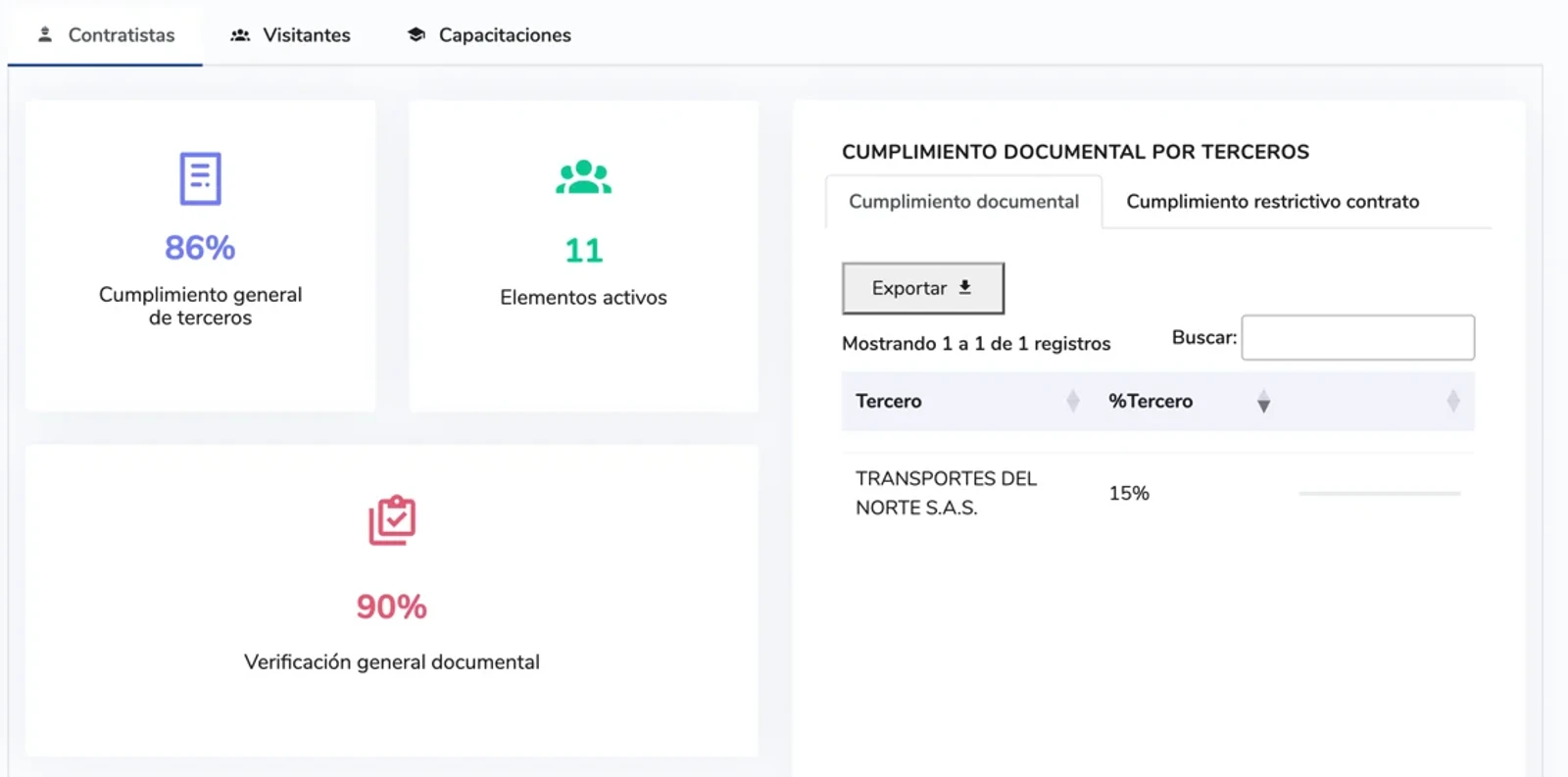
Both flows get the same answer at the gate
-

The day is on record
The platform
Which solutions are involved in this industry
NAVA is three solutions on the same platform. This is the role each one plays in an operation like yours.

Recurring contractors and logistics operators: document requirements matrix by job, expiration tracking, vehicles and machinery, and entry lookup.
See NAVA 360 →
Occasional visitors and technicians: unique self-registration link and QR code, the documents the terminal requires, visitor induction, and the host’s pre-approval.
See NAVA ID →
Training over WhatsApp for operations staff, with an in-chat assessment and a PDF certificate.
See NAVA Skills →This is the industry where the first two solutions carry equal weight: without NAVA ID, the occasional visitor ends up being handled at the gate, which is exactly what you need to avoid.
Regulatory framework
Applicable regulations and how they translate into documents
NAVA doesn’t interpret the regulations: it manages the documents the terminal uses to show the control it exercised.
| Framework | What it requires | How it shows up in the document requirements matrix |
|---|---|---|
| Decree 1072 of 2015 | The hiring company’s obligations under its OHS (occupational health and safety) management system (SG-SST) toward third parties who enter its operation | ARL, EPS, and pension enrollments, medical exams, and terminal induction |
| Resolution 0312 of 2019 | Minimum SG-SST standards by company size and risk class | Differentiated requirements by job and by activity |
| Resolution 4272 of 2021 | Minimum safety requirements for work at heights, more than two meters above floor level | Work-at-heights certificate as an entry-restrictive document |
| Port regulations applicable to the terminal | The port operation’s own regulatory framework | Configured as the terminal’s own requirements, with their validity period and their approver |
Frequently asked questions
Questions about third-party control in Ports and High-Volume Operations
We handle hundreds of entries a day. Doesn’t this slow down the gate?
Validation no longer happens there. Documents are uploaded and approved beforehand; at the gate, you only look up an ID number, license plate, or serial number, and the system answers with the status calculated at that moment.
We have regular contractors and visitors who come only once. Are those two systems?
Is there a record of the day’s entries and exits?
Yes. The entry control report can be filtered by period and by the lookup fields, and exported to Excel.
The job is before dawn. Does the control work outside office hours?
Yes. The status is calculated at the moment of the lookup and doesn’t depend on anyone in the office confirming anything.
What can we require from an occasional visitor?
Whatever documents the terminal defines, plus the visitor induction with its assessment. The visitor provides them during self-registration, before arriving.
The crew changes from one job to the next. Do we have to onboard the company again?
No. The company is onboarded once; each new person is created as another element, with the requirements of the job they’ll perform.
Does NAVA need a different setup for each industry?
The document requirements matrix is configured with your company’s requirements, and those requirements change from one industry to the next. The system is the same: what you configure are the documents, validity periods, approvers, and which document blocks what.
Demo
See NAVA with your terminal’s entry flow
We set up both flows (recurring contractors and visitors) and the single lookup your gatehouse would use during the morning peak. You leave with a written price proposal.
- Colombian software
- 30-day trial
- OHS validation available
- Support in Spanish