
Industries · Multi-Site Companies
Contractor management for multi-site companies
Each site or project has its own contractors and its own people in charge of verification. In NAVA, requirements are defined once for the whole company, based on the activity each third party will perform, and compliance can be viewed by site, by project, or all together.
The third party exists only once on the platform, with its people, vehicles, and machinery. Whether it works at one site or five, it uploads its documents only once.

Critical moment in multi-site companies
Consolidating the corporate indicator
- Who comes in
- Contractors and suppliers who work at several sites
- Elements under control
- People · vehicles · machinery, in a single record per third party
- Answer at the gatehouse
- Cleared for entry: yes or no
Context
Seven sites, specific control for each one
A company with several plants and administrative offices doesn’t have a problem of intent: it has one of accumulation. Each site solved control when it needed to, with whatever it had on hand.
The problem shows up at the top. Management gets seven answers built with different criteria, and when it tries to impose a single list, the plant pushes back because half of it doesn’t apply.
NAVA solves it with a single document requirements matrix for the whole company, where what sets one third party apart from another is the activity it performs. Each site and each project keeps its own people in charge of verification, and compliance is calculated the same way at all of them.
The problem
What makes third-party control hard when there are several sites
Situations your team will recognize, and what happens today when control depends on a spreadsheet and on the memory of whoever is at the door.
-
Each site solved the problem on its own
One keeps an Excel file, another a shared folder, another relies on the memory of whoever is at the gatehouse.
None of them is wrong, but they can’t be added up: there’s no corporate figure that comes from putting them together.
-
Not all third parties do the same thing
The person who’ll be welding at the plant and the person making a delivery to the administrative office don’t need to submit the same documents: what changes is the activity, not the address they arrive at.
A single list for everyone asks too much of some and too little of others, and ends up being the one nobody complies with.
-
Management has no comparable figure
Seven reports in seven formats aren’t a corporate indicator, and each one calculates compliance its own way.
The question “How are we doing on third-party control?” has no answer anyone can defend.
-
The same contractor works at several sites
And ends up uploading its documents once for every site that asks for them, to different people and in different formats.
The work multiplies without improving control, and the contractor gets tired of the process.
-
Turnover of the person in charge
Control depends on who runs it at each site, and when that person changes roles, the criteria leave with them.
The continuity of control doesn’t live in the procedure; it lives in a person.
Document requirements matrix
The documents your operation requires
The matrix turns your company’s procedure into rules the system applies: which element each document is required for, under which activity, with what validity period, who approves it, and what gets blocked when it expires.
- Entry The person or vehicle can’t enter while the document is expired or rejected.
- Use The equipment or machinery is disabled from operating.
- Contract It affects the continuity of the relationship with the contractor company.
| Document | Applies to | Blocks | Operational note |
|---|---|---|---|
| Current enrollment with an ARL (occupational risk insurer), EPS (health insurer), and pension fund | People | Entry | Common requirement: part of the general activity that applies to all third parties |
| Valid occupational medical exam | People | Entry | With the emphases the activity requires |
| Certifications by activity | People | Entry | This is where the real difference lies: each activity requires its own |
| Work-at-heights certificate | People | Entry | Wherever there are activities more than two meters above floor level |
| SOAT (mandatory vehicle insurance) and technical-mechanical inspection | Vehicles | Use | |
| Equipment inspection certificate | Machinery | Use | |
| Civil liability insurance policy | Company | Contract | At the corporate level |
| Corporate induction | People | Entry | With its validity period and its minimum passing score |
Each requirement is configured once with its validity period, its approver, and its review criteria. Entry override is available as an exception, with a named person responsible and a justification.
How it works
Who does what, from onboarding to the gatehouse
Your team manages the relationship, the third party uploads their information, and NAVA applies the rules throughout the cycle. These are the five stages in multi-site companies.
- 01
Management
Defining the requirements
The company’s document requirements matrix is configured: the general activity with what’s required of every third party, and the specific activities with their own requirements. This is the part that makes the indicator comparable.
- 02
Each site or project
Assigning responsibilities
Each work site and each project has its own people in charge of verification, who review using the criteria defined in the matrix.
- 03
The contractor
Single upload by the third party
It registers its people and equipment once, and is linked to the activities it performs and the work sites and projects where it operates. It doesn’t repeat the upload for each site.
- 04
Each site’s team or the NAVA back office
Validation
Documents are approved, rejected with a comment, or left pending, using the criteria defined in the matrix.
- 05
Management
Consolidated view
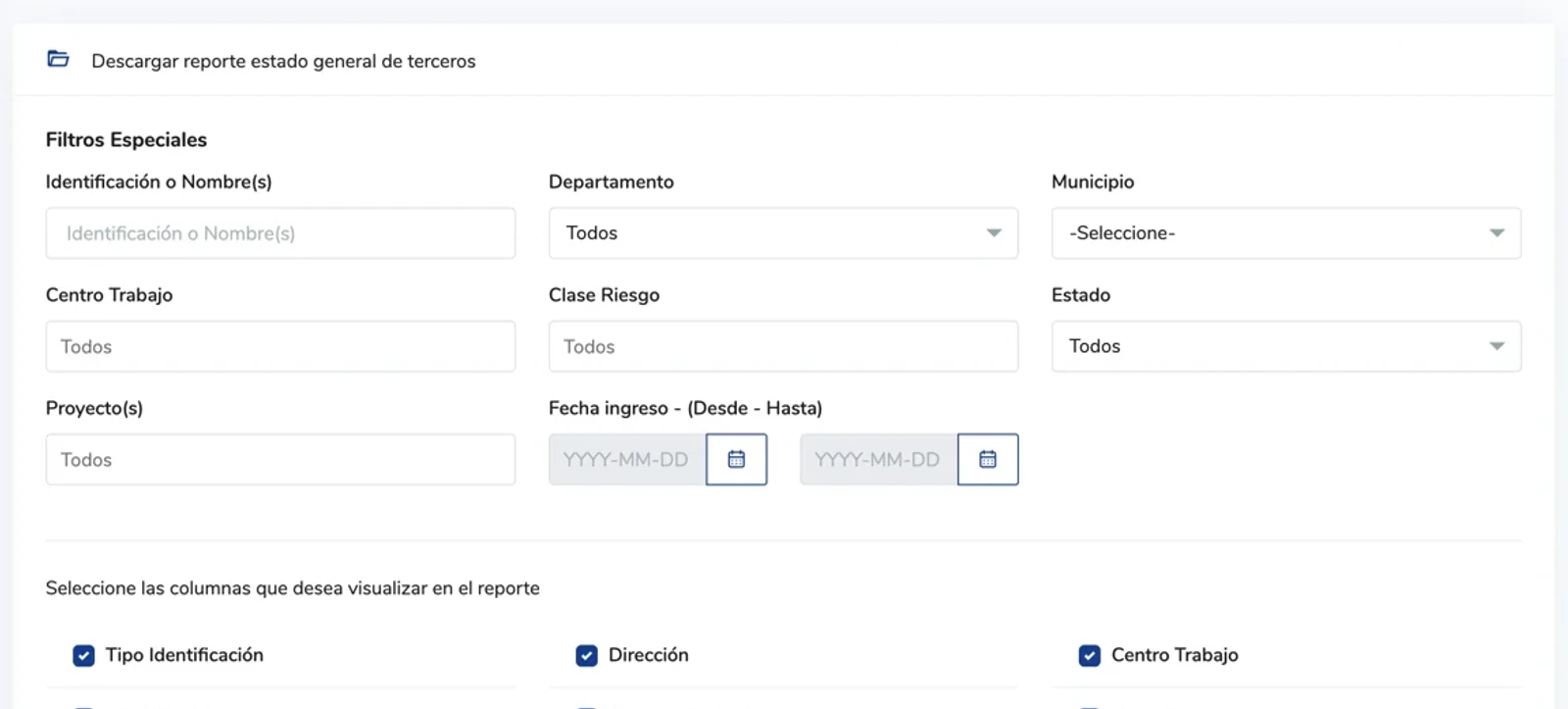
Reports can be filtered by work site, project, department, or municipality, and exported: documents uploaded, approved, and rejected, inductions, and overall compliance.
The platform
Which solutions are involved in this industry
NAVA is three solutions on the same platform. This is the role each one plays in an operation like yours.

Corporate general activity, requirements by type of activity, a single record per third party, and reports filterable by work site and project.
See NAVA 360 →
Visitors at administrative and commercial offices: self-registration through a link or QR code, and the host’s pre-approval.
See NAVA ID →
Training over WhatsApp with the same content for staff at every site, with a PDF certificate.
See NAVA Skills →All three share one platform and database and are contracted separately. In a multi-site operation, NAVA Skills solves the other standardization problem: making sure every site gets the same training.
Regulatory framework
Applicable regulations and how they translate into documents
NAVA doesn’t interpret the regulations: it manages the documents the company uses to show the control it exercised at each of its sites.
| Framework | What it requires | How it shows up in the document requirements matrix |
|---|---|---|
| Decree 1072 of 2015 | The hiring company’s obligations under its OHS (occupational health and safety) management system (SG-SST) toward third parties who enter any of its sites | ARL, EPS, and pension enrollments, medical exams, and induction |
| Resolution 0312 of 2019 | Minimum SG-SST standards by company size and risk class | Differentiated requirements by type of activity, on top of a common baseline |
| Resolution 4272 of 2021 | Minimum safety requirements for work at heights, more than two meters above floor level | Work-at-heights certificate wherever the activity requires it |
Frequently asked questions
Questions about third-party control in Multi-Site Companies
Do all third parties have to submit the same documents?
No, and that’s why the document requirements matrix is configured by type of activity. There’s a general activity that applies to all third parties (the common corporate baseline), and each specific activity adds its own requirements on top of it.
A contractor works at three of our sites. Does it have to upload its documents three times?
No. The third party exists only once on the platform, with its elements and its documents, and it’s linked to the work sites, activities, and projects where it operates.
Can management see compliance for all sites together?
Yes. Indicators are calculated with the same rule at every work site, so the figures are comparable with each other.
Can the induction be mandatory for entry?
Yes. The induction is configured with its content, its assessment, its minimum passing score, its validity period, and its restrictive nature. If it’s entry-restrictive, anyone who hasn’t completed it can’t enter, even if the rest of their documents are up to date.
Can users at each site see the other sites’ information?
It depends on the profile. Permissions are defined by menu option, so the person in charge of a site can see their own and management can see the consolidated view. See technology and security.
Can we export data by site for a committee meeting?
Yes. Reports can be filtered by the lookup fields, including work site, and exported to Excel.
Does NAVA need a different setup for each industry?
The document requirements matrix is configured with your company’s requirements, and those requirements change from one industry to the next. The system is the same: what you configure are the documents, validity periods, approvers, and which document blocks what.
Demo
See NAVA with your sites’ structure
We set up your company’s document requirements matrix and the reports management uses to view compliance by site and by project. You leave with a written price proposal.
- Colombian software
- 30-day trial
- OHS validation available
- Support in Spanish